Skip to content

Designing Digital Worlds Communities, Protocols, AI, and Power - Andrés Monroy Hernández

LectureAndrés Monroy-Hernández
Designing Digital Worlds Communities, Protocols, AI, and Power - Andrés Monroy Hernández

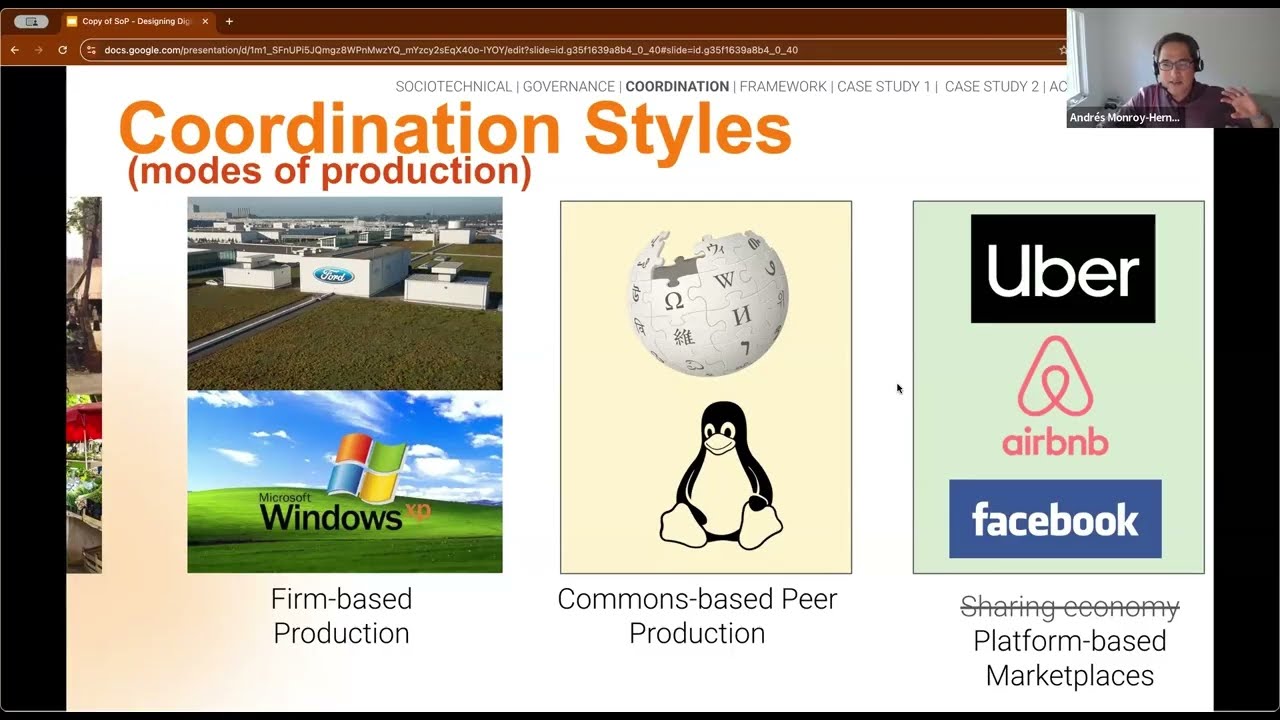
Andrés Monroy-Hernández and Soyeon (So-young) outline a Princeton course on 'designing digital worlds,' tracing a lineage from Elinor Ostrom's commons governance and Yochai Benkler's commons-based peer production to today's decentralized social media protocols (ActivityPub, AT Protocol, Nostr, Farcaster), arguing each architecture encodes distinct political trade-offs around identity, curation, and infrastructure power. So presents her research on 'governance frictions' between federated communities and proposes design concepts like 'governance nutrition facts,' 'trust bubbles,' and an 'issue bulletin' to help fediverse moderators coordinate across incompatible norms.</br>

Related resources

Lecture

Protocolized Modeling and Verification of Cyber Physical Systems - Giovanni Merlino

Giovanni Merlino, professor of computer science engineering at the University of Messina, presents the redesigned final module of his cyber-physical systems (CPS) course, framing formal verification techniques—linear temporal logic (LTL), finite state machine equivalence/refinement, and model checking—as a form of 'protocolization' that makes hidden assumptions, tradeoffs, and human-machine interactions explicit. He walks through concepts like safety vs. liveness properties, simulation vs. bisimulation, the CEGAR (counter-example guided abstraction refinement) technique, and Büchi automata, ultimately proposing a layered model (robot-level, swarm-level, smart-city-level) where engineering tensions like hyper-safety vs. liveness or pedestrian priority vs. system efficiency require explicit governance levers.

Giovanni Merlino

Talk

Psychological Safety I & II

Timber Stinson-Schroff argues that AI's workplace effects should be studied through occupational health frameworks rather than existential-risk AI safety, proposing 'cognitive ergonomics' as a better term than 'psychological safety' since it emphasizes chronic, long-term pathologies (like carpal tunnel from typewriters) over acute incidents. Drawing on the safety-one/safety-two distinction from traditional safety literature, Stinson-Schroff advocates crowdsourcing a database of AI usage hazards and pathologies—such as the 'yes man problem' from fast LLM responses and speech pattern changes—toward an eventual diagnostic manual, while cautioning against liability blind spots given the slow, second-order mechanisms by which these harms emerge.

Timber Stinson-Schroff

Talk

Trust Experience Glitches: AI Agents, Delegated Autonomy, and Legitimacy

Helena Rong (Assistant Professor at NYU Shanghai, director of the Protopolis Lab) presents a taxonomy of 'trust experience glitches'—six failure modes (agency assertion, epistemic camouflage, delegation ambiguity, opacity at scale, cascading autonomy, revocation failure) drawn from a 167-incident dataset of agentic AI failures. She argues these ruptures expose a 'consequence reception problem' where autonomous agents lack a stable body to bear accountability, and proposes that governance must shift from ex-post legal remedies toward upstream protocol primitives (capability-based permissions, provenance tracking, action-class legibility, circuit breakers, revocability) as the 'traffic lights' of the agentic web.</summary>

Helena Rong