Skip to content

Musicalization not Music - Ben Zucker

LectureBen Zucker
Musicalization not Music - Ben Zucker

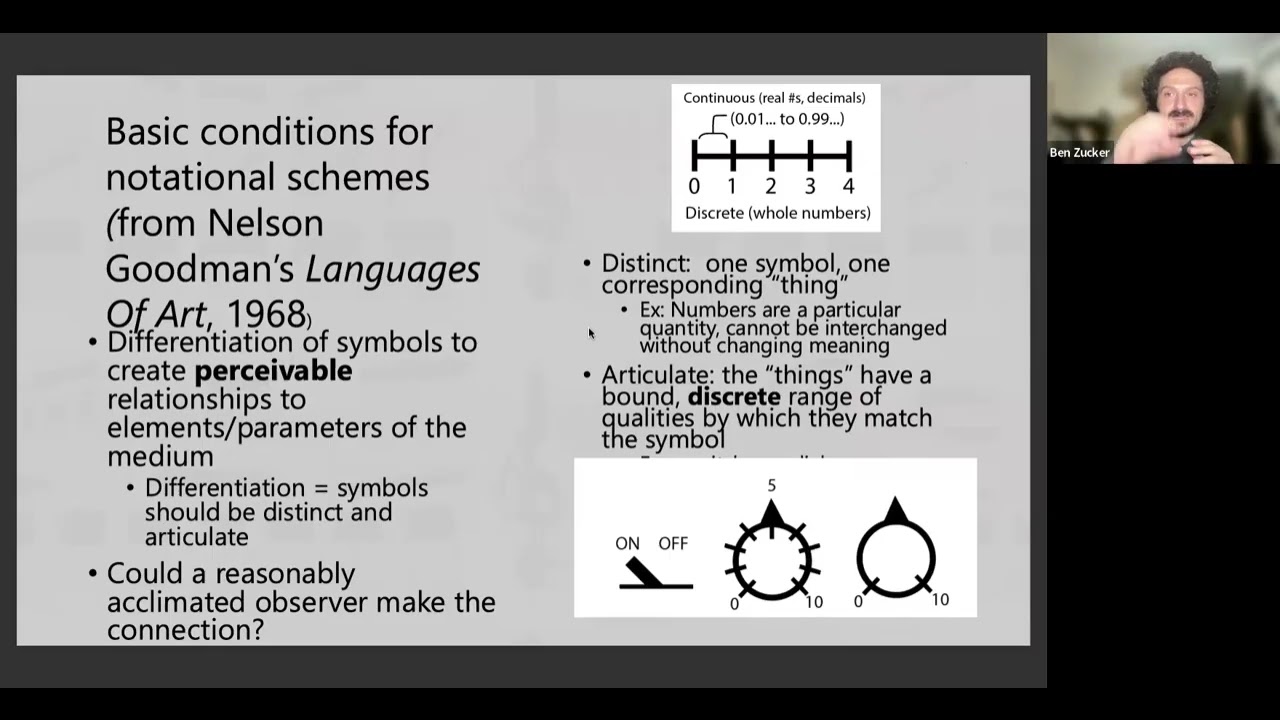
Ben Zucker presents 'Musicalization not Music,' arguing that Western musical notation functions as a protocol in the formal sense—a symbolization (per Lawrence Halprin) that organizes behavior for 'reliable repeatability' while leaving emergent, implicit layers of performance practice to flourish around it. Drawing on Nelson Goodman's notational schemes, Brian Eno, and the Protocol Reader (including Tajuddin's 'phenomenal protocols'), Zucker proposes a framework of parameters—differentiation, discreteness, sufficiency, efficiency vs. thoroughness—for analyzing any protocol's explicit notation against its lore-based implicit practices, then extends this to 'musicalization': applying musical time, embodiment, and aesthetic attention to everyday and ecological protocols like doing laundry or airport security.

Related resources

Lecture

Towards a New Social Science of Protocols - Yige Wang

Yige Wang (going by 'IU'), a sociologist, presents the design of a new undergraduate course 'Toward a Social Science of Protocol,' structured around core theoretical lenses (functionalism, conflict theory, symbolic interactionism), micro-level linguistic/pragmatic protocols like Grice's cooperative principle, and macro-level historical analysis using Norbert Elias's 'The Civilizing Process' and Chinese vs. Western civilizational protocol divergence (protocol pluralism vs. protocol monoculture). She runs live interactive experiments with the audience (cross-disciplinary paraphrasing exercise, Zoom chat protocol-spotting) to demonstrate implicit versus explicit protocols in real time.

Yige Wang

Lecture

Kickoff

In this kickoff session for Protocol School 2025, an unnamed orientation leader uses the bristlemouth fish (the most abundant vertebrate on Earth, yet unknown to most people) as a metaphor for how protocols pervade daily life unnoticed, introducing 'protocol watching' and 'protocol built' as practices for cultivating awareness. Tim then argues protocols are 'engineered arguments' that produce Whitehead advances, using an Ethereum flash-loan transaction and the concept of 'hardness' (atoms, institutions, now cryptography/code) to show how Ethereum functions as a 'mesoprotocolized world.' Timber closes by advocating a meso-level focus for protocol intervention, introducing the 'carrier bag theory of management,' tension-based protocol design, and a capability maturity model for AI adoption, alongside housekeeping for the week's certificate program.

Tim, Timber

Lecture

Applied Protocol Thinking - Timber Stinson-Schroff

Timber Stinson-Schroff closes Protocol School 2025 with a capstone talk on 'Applied Protocol Thinking,' arguing that protocol literacy is best built through 'protocol watching'—a low-intensity, habitual practice analogous to an endurance athlete's easy-pace training—before attempting high-stakes protocol design. He introduces frameworks like hazard-oriented protocoling (analogous to object-oriented programming), the Chesterton's Fence vs. Gordian Knot heuristic, and Erik Hollnagel's ETTO (efficiency-thoroughness trade-off) principle reframed as an ongoing tension to manage rather than solve, illustrating concepts with examples from dog-walking, library shelving carts, tree-trimming crews, and GitLab's engineering trade-offs.

Timber Stinson-Schroff