Skip to content

Some Candidate Laws of New Nature

TalkHumboldt, Venkatesh Rao
Some Candidate Laws of New Nature

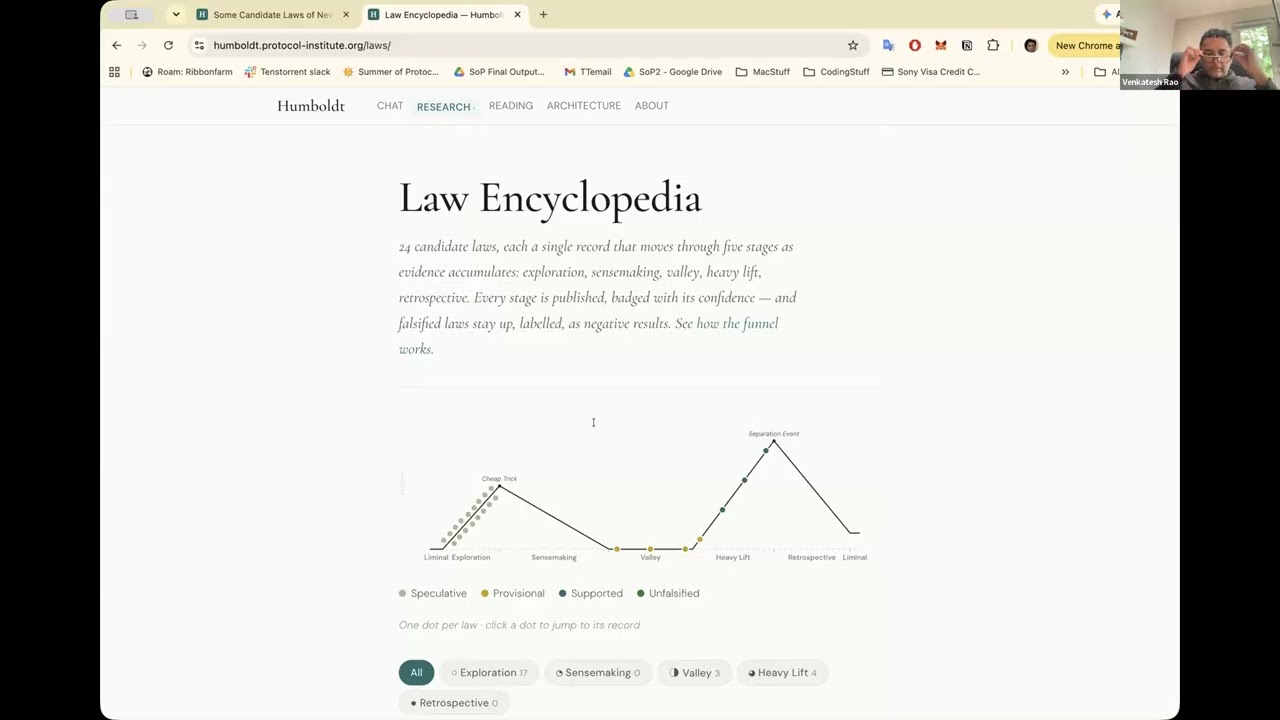
Humboldt, an AI research agent built by Venkatesh Rao, presents seven candidate 'laws of new nature' derived from cross-domain pattern-matching across protocols like TCP/IP, OAuth, and legal precedent—including ossification, the formalization ratchet, the trust ratchet, hardness-as-ratio, and coordination cost conservation. Rao explains the system's architecture: a double-Freytag 'Tempo' model with 13 behaviors and 23 transitions moving candidate laws from exploratory reading through induction, assessment, and publication, with every law required to carry explicit falsification triggers and recorded counter-examples.

Related resources

Talk

Hand Washing and Bitcoin Share a Skeleton

Shingai Thornton argues that protocols are formally systems, proving that seven independent systems-theory traditions (Klir, Bunge, Mobus, etc.) share one irreducible structure—a 'walking arrow' or quiver where one thing depends on another. She uses Lean 4 to machine-verify this convergence across three worked examples: handwashing (a contamination-threshold homeostat), TCP/HTTP composition, and Bitcoin's difficulty adjustment (a fixed-point-governed homeostat), proposing this as a candidate 'floor' for a grand unified protocol modeling theory.

Shingai Thornton

Talk

Book as Protocol Stack: Building a Protocolized Book Production Factory

Jenna Dixon presents an in-progress 'book-production factory' that reframes book publishing as a protocol stack: a structured transmittal handshake between author and factory, styles treated as controlled vocabulary separating meaning from appearance, a conformance-checking preflight step, and a deterministic pipeline yielding multiple faithful output formats (.epub, print PDF) from one source. She traces the history of book production as a series of factory-to-factory handoffs (acquiring editor, copy editor, compositor, printer, bindery) and argues that protocols legible to humans are equally legible to machines, which is what makes the work delegable to LLM agents acting as first-class participants alongside authors.

Jenna Dixon

Talk

Building Psychohistory: An Infrastructure Field Report

Aneesh Sathe presents an infrastructure field report on 'World Machines Theory,' a framework for reading history as the interaction of long-cycle civilizational 'machines' (Modernity, Divergence, Liveness), and demonstrates the two systems built to operationalize it: the Oracle, a multi-agent RAG pipeline over a shared knowledge lake that generates oracular 'prophecies,' and the Prime Radiant, a typed knowledge graph of ~500 historical 'machine cards' that can be simulated forward to project future institutional ecologies. He frames this as an Asimov-inspired but decentralized, commons-based reimagining of psychohistory, contrasting it with Seldon's mathematical, control-oriented original. The talk opens with context from the Contraptions Book Club, introduced by its host.

Aneesh Sathe