Skip to content

Time Moves Down the Stack

TalkFlorian Lohse
Time Moves Down the Stack

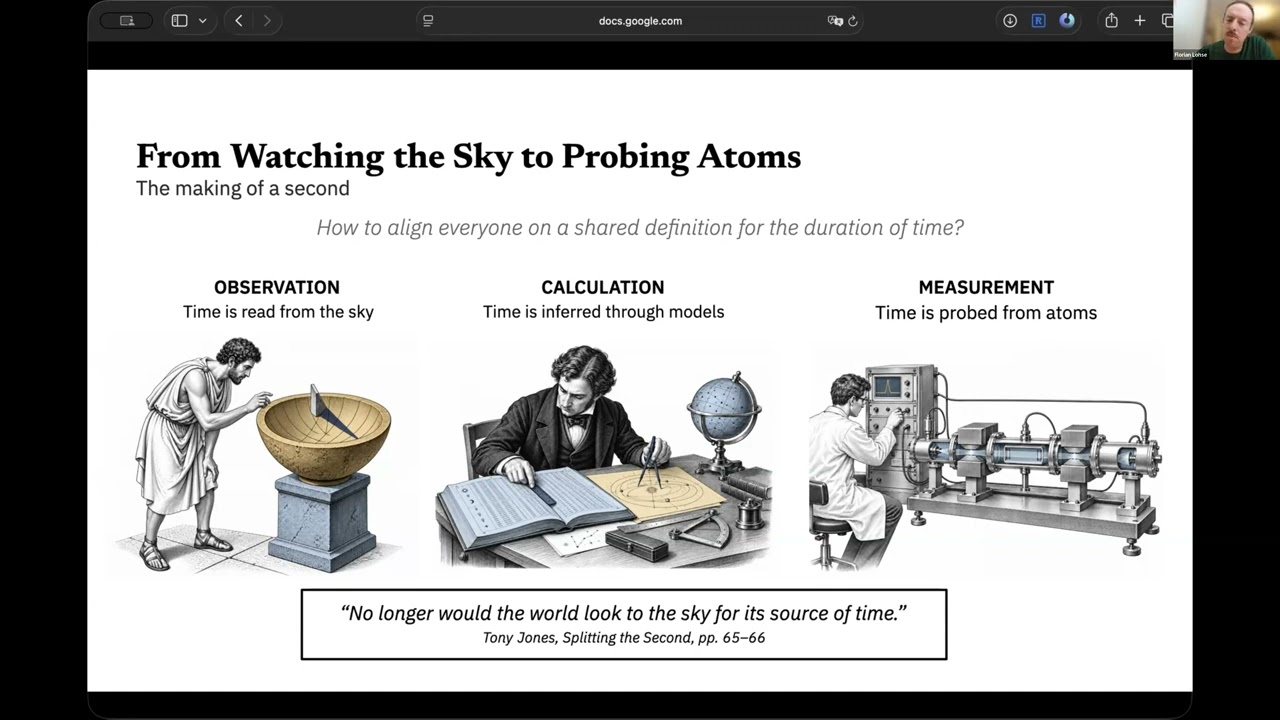
Florian Lohse synthesizes three books on time's history—David Landes on clock evolution, Tony Jones on atomic timekeeping, and Wolmar and Stein's essay collection on 'hardwired temporality'—to argue that timekeeping has migrated deeper into technical infrastructure, culminating in an emerging 'micro time' regime operating below human perceptual thresholds. Drawing on his 2014 master's thesis on time-management devices, he contends this shift enables machine 'preemption' (decisions made before humans can react, as in VR eye-tracking), and that personal time-management practices are becoming either resistance or mere coping mechanisms as agency over time recedes into infrastructure.

Related resources

Talk

Hand Washing and Bitcoin Share a Skeleton

Shingai Thornton argues that protocols are formally systems, proving that seven independent systems-theory traditions (Klir, Bunge, Mobus, etc.) share one irreducible structure—a 'walking arrow' or quiver where one thing depends on another. She uses Lean 4 to machine-verify this convergence across three worked examples: handwashing (a contamination-threshold homeostat), TCP/HTTP composition, and Bitcoin's difficulty adjustment (a fixed-point-governed homeostat), proposing this as a candidate 'floor' for a grand unified protocol modeling theory.

Shingai Thornton

Talk

Building Psychohistory: An Infrastructure Field Report

Aneesh Sathe presents an infrastructure field report on 'World Machines Theory,' a framework for reading history as the interaction of long-cycle civilizational 'machines' (Modernity, Divergence, Liveness), and demonstrates the two systems built to operationalize it: the Oracle, a multi-agent RAG pipeline over a shared knowledge lake that generates oracular 'prophecies,' and the Prime Radiant, a typed knowledge graph of ~500 historical 'machine cards' that can be simulated forward to project future institutional ecologies. He frames this as an Asimov-inspired but decentralized, commons-based reimagining of psychohistory, contrasting it with Seldon's mathematical, control-oriented original. The talk opens with context from the Contraptions Book Club, introduced by its host.

Aneesh Sathe

Talk

Protocols for Co-Cognition: The New Nature of Collaboration in the AI Era

Robert Peake presents empirical findings from his AI Co-Working Effectiveness Survey, which maps respondents onto a Sovereignty-versus-Trust grid yielding four postures (Partnership, Hypervigilance, Overreliance, Compliance) and measures cognitive load, debt, dissonance, and sovereignty. He argues that adoption level does not predict cognitive cost—posture does—and proposes explicit protocols like a 'DRIVE' loop (Decide, Request, Iterate, Validate, Evolve) and externalized tooling (e.g., knowledge-promotion taxonomies, forced session-closing rituals) to convert fragile human vigilance into durable, low-cost guardrails against AI-induced deskilling.

Robert Peake