Skip to content

Designing Trust Protocols, Society, and Web 3.0 - Helena Rong

LectureHelena Rong
Designing Trust Protocols, Society, and Web 3.0 - Helena Rong

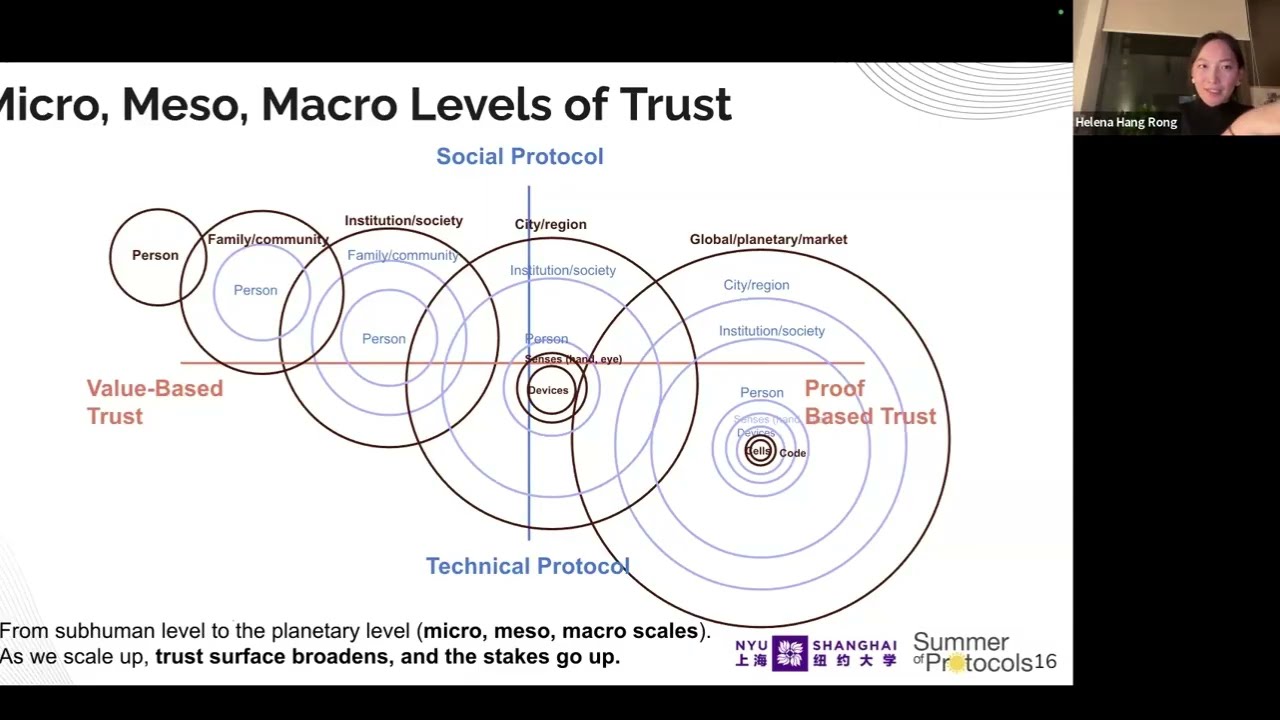
Helena Rong, assistant professor at NYU Shanghai, previews her spring 2026 course on trust protocols for the agentic web, introducing 'trust experience design' as a framework with three layers—evidence (cryptographic attestations), primitives (verifiable credentials, zero-knowledge proofs), and rituals/experience (signals that make trust felt). She traces trust's evolution from value-based/social forms (handshakes, institutions) to proof-based/technical forms (blockchains, smart contracts), and discusses decentralized AI agents (DeAgents) like Truth Terminal and Sporef.fun as cases of emerging AI self-sovereignty that outpace existing trust protocols like A2A and ERC-8004. The session concludes with a group exercise where participants design trust protocols for near-future scenarios like autonomous mobility, smart grids, and robotic surgery.

Related resources

Lecture

Protocol Art II - Primavera De Filippi & Felix Beer

Primavera De Filippi leads a seminar on protocol art, working through audience case studies (role-playing games, choreography, Yanis Xenakis scores, PostSecret, Pak's Merge/Censored) to test the boundaries between protocol-as-tool, protocol-as-medium, and mere mimetic/meme art. She then presents two archetypal case studies, Oli Plus and Plantoid, analyzing distributed authorship, asynchronous collaboration, DAO-based governance, the limits of copyright versus personality rights, automated royalty systems, community roles, and the temporal/evolutionary nature of protocol-based artworks.

Primavera De Filippi, Felix Beer

Talk

De-Dramatizing the Digital: How AI Descends Into New Nature

Sean Stevenson argues that AI is undergoing a 'descent' through Stewart Brand's pace layers—moving from fast fashion/commerce layers down through governance and culture toward nature itself—becoming less dramatic and less contestable as it sinks, following a pattern he traces via Clayton Christensen's theory of attractive profits migrating to the least-optimized layer of a value chain. He proposes a four-stage model (integrate, coordinate, embed, inherit) for this descent and introduces 'appeal foreclosure' versus 'ossification' as a way to distinguish genuine new nature from captured systems, while drawing on Spinoza's natura naturans/naturata and Philippe Descola's ontological framework (naturalism, animism, totemism, analogism) to speculate how AI-plus-protocols might shift human categories of inner life and matter.

Sean Stevenson

Lecture

Protocols of Storytelling - Qiufan Stanley Chen

Stanley Qiufan Chen, author of Waste Tide and co-author with Kai-Fu Lee of AI 2041, teaches a workshop on 'protocols of storytelling,' arguing that meaning in fiction emerges from a shared protocol-space between author and reader—genre conventions, causal layer analysis (Sohail Inayatullah's four layers: litany, systemic causes, worldview, myth/metaphor), and a 'constraint-driven focus' that keeps every narrative choice traceable back to a story's core idea. He guides participants through an iterative 'seed-root-flower-fruit' exercise, using works like The Matrix, Evangelion, and Arrival to show how deep protocols (myth, worldview) are harder to change than surface elements (plot, imagery), and how human-first, AI-assisted co-writing can deepen rather than flatten speculative fiction.

Qiufan Stanley Chen