Skip to content

Protocol Design as Governance - Eric Alston

LectureEric Alston
Protocol Design as Governance - Eric Alston

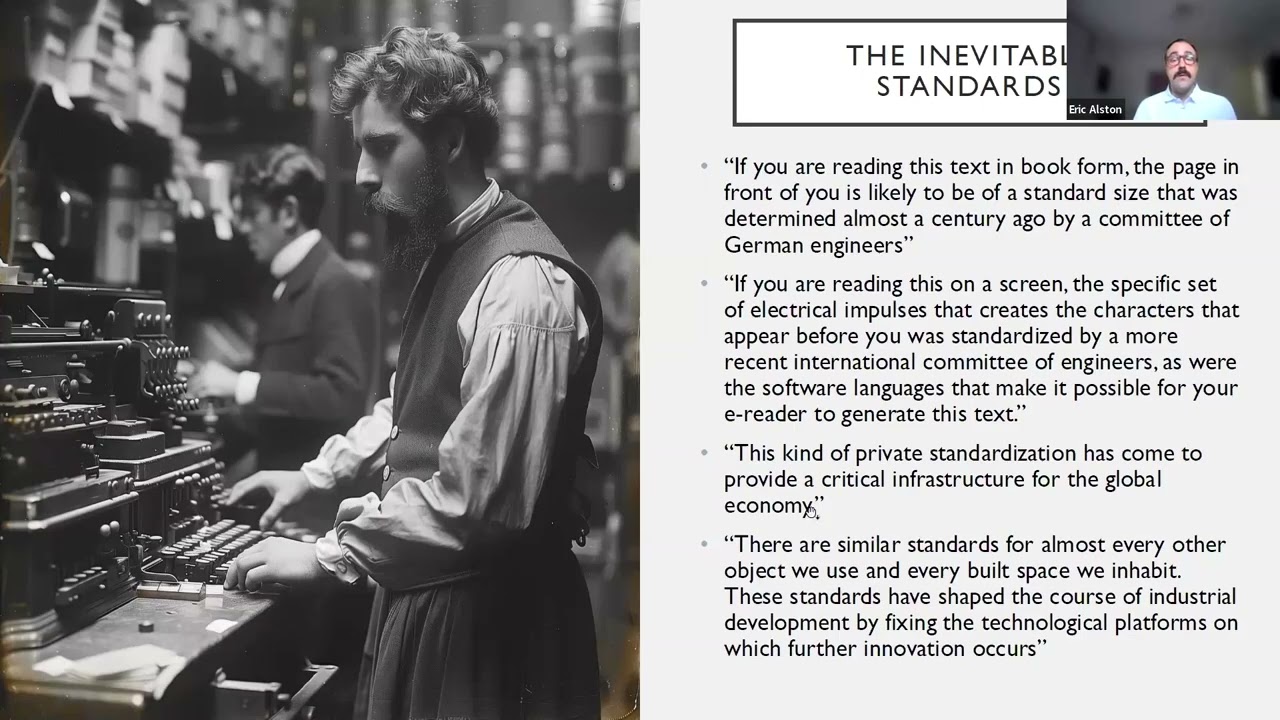
Eric Alston presents a curriculum module for his blockchain and finance students, arguing that protocol design functions as governance across four domains: standards, networks, complexity/uncertainty, and constitutive choice. He draws on readings from David Lang, Venkatesh Rao, and his own institutional economics work to argue that protocols are a 'scalar mechanism' for human coordination, distinguishing institutions (exogenously enforced, foreseeable rules) from norms (emergent, ubiquitous constraints), and uses modularity theory to explain how complex systems 'imprison' complexity within subsystems via constitutional-like interfaces.

Related resources

Lecture

Protocol Art II - Primavera De Filippi & Felix Beer

Primavera De Filippi leads a seminar on protocol art, working through audience case studies (role-playing games, choreography, Yanis Xenakis scores, PostSecret, Pak's Merge/Censored) to test the boundaries between protocol-as-tool, protocol-as-medium, and mere mimetic/meme art. She then presents two archetypal case studies, Oli Plus and Plantoid, analyzing distributed authorship, asynchronous collaboration, DAO-based governance, the limits of copyright versus personality rights, automated royalty systems, community roles, and the temporal/evolutionary nature of protocol-based artworks.

Primavera De Filippi, Felix Beer

Lecture

Strategy as an Organizational Coordination Protocol for the Public Sector - Vaughn Tan

Vaughn Tan presents a prototype session from a new executive-education course on public sector strategy, arguing that strategy should be redefined as 'making reasoned subjective arguments about acceptable trade-off configurations' rather than planning or objective-setting, framing it explicitly as a coordination protocol for decentralized hierarchies. He critiques how public sector strategy has inherited mid-20th-century American private-sector frameworks (business policy model, SWOT, NPM) ill-suited to public contexts, illustrates coordination failures via Grenfell Tower and desert-city flooding, and introduces the Knightian risk/uncertainty distinction (using WHO's COVID travel-restriction guidance) to argue public servants mismanage uncertainty by treating it as calculable risk. He also proposes 'parametric cases'—short, highly localized, content-specific teaching cases—as a pedagogical fix for traditional long, decontextualized business-school case studies.

Vaughn Tan

Lecture

Designing Digital Worlds Communities, Protocols, AI, and Power - Andrés Monroy Hernández

Andrés Monroy-Hernández and Soyeon (So-young) outline a Princeton course on 'designing digital worlds,' tracing a lineage from Elinor Ostrom's commons governance and Yochai Benkler's commons-based peer production to today's decentralized social media protocols (ActivityPub, AT Protocol, Nostr, Farcaster), arguing each architecture encodes distinct political trade-offs around identity, curation, and infrastructure power. So presents her research on 'governance frictions' between federated communities and proposes design concepts like 'governance nutrition facts,' 'trust bubbles,' and an 'issue bulletin' to help fediverse moderators coordinate across incompatible norms.</br>

Andrés Monroy-Hernández